
In its 59-page order, the capital markets regulator Sebi said that the 10-year restraint period for them would be calculated after taking into account the restraint already undergone by him vide an interim order dated June 17, 2010.

The rupee weakened by 14 paise to close at a new lifetime low of 79.59 against the US dollar on Tuesday as a strong greenback overseas and persistent foreign fund outflows continued to weigh on investor sentiment. This comes a day after the RBI announced measures for international trade settlement in rupees. At the interbank forex market, the local unit opened weak at 79.55 against the greenback and witnessed an intra-day high of 79.53 and a low of 79.66.

With high credit growth and healthy asset quality, listed commercial banks are expected to report steady growth in earnings during the fourth quarter ended March 2024 (Q4 FY24). Profits are expected to grow at 9.6 per cent year-on-year (Y-o-Y) and net interest income (NII) by 8.7 per cent in Q4 FY24, according to Bloomberg analysts' estimates. According to Motilal Oswal Securities, while bank credit growth has been robust, deposit growth has also gathered pace.

The first-quarter performance of top IT services players, as well as mid-cap firms, has been subdued, reflecting macro uncertainties. The numbers of the top four firms show several misses, hinting at difficult times ahead. One mismatch is the total contract value (TCV) signed by the firms and the revenue growth registered.

'If individual stocks start falling 25% to 30% or more, then I doubt how many of them will be able to withstand that (kind of selloff). That is when you'll see panic coming in.'

Axis Bank, Tata Steel, Kotak Mahindra Bank, ICICI Bank, Tata Motors, and Bajaj Finance were among the other major laggards. Tata Consultancy Services, Reliance Industries, UltraTech Cement, Infosys, HCL Technologies, and Tech Mahindra were among the gainers.

Private banks' net profit grew 26.3 per cent year-on-year (Y-o-Y) to Rs 48,982 crore in the first quarter ended June 2024 (Q1FY25) owing to healthy growth in credit and other income. The gross non-performing assets (GNPAs) increased with the end of dispensation granted during the pandemic, according to the data compiled by BS Research Bureau for listed 18 private banks.

Equity benchmarks Sensex and Nifty ended on a mixed note on Wednesday as the euphoria about the Budget fizzled out, with investors going for profit-taking ahead of the Fed interest rate decision. The 30-share BSE benchmark Sensex climbed 158.18 points or 0.27 per cent to settle at 59,708.08 after it trimmed most of the intra-day gains. During the day, it had zoomed 1,223.54 points or 2 per cent to 60,773.44.

HDFC Bank had opened multiple demand accounts which were used for manipulation of the IPO allotment process in the last few years, but those were not held in benami names.

Infosys was the only large-cap IT player to report sequential constant currency (cc) revenue growth for the June quarter (1 per cent ), which was ahead of analyst expectations, but the company's sharp downward revision in its growth guidance took most brokerages by surprise. In line with the cut in its FY24 revenue guidance (cc) to 1-3.5 per cent, brokerages have unanimously reduced FY24 EPS estimates for the company in the range of 2-4 per cent, though the Street is likely fearing even further downside, they say. Global brokerages Macquarie and Nomura downgraded Infosys to underperform and reduce ratings, respectively, with the latter cutting the target price to Rs 1210 from Rs 1260.

Do not get repair work started without informing the insurer as the latter like to carry out end-to-end verification of damages and documents before approving a claim.

India's first-ever listed new-age company, Zomato, has seen a meteoric rise in its stock price in calendar year 2023 (CY23), rising 70.75 per cent during this period as compared to 9.5 per cent rise in the S&P BSE Sensex. From being the second worst hit new-age stock in CY22, crashing 57 per cent on the National Stock Exchange (NSE), the stock hit the Rs 100-mark for the first time since January 2022 in late August. The stellar run in the stock - only after PB Fintech and One97 Communications-owned Paytm, analysts say, may be coming to an end, at least for now.

Urban housing mortgage major HDFC announced that it will cut its lending rates by the end of the week.

Consider a combination of a base policy and a super top-up policy.

Lawyers say compensation may be an uphill task for investors because of a lack of judicial precedent and broader institutional difficulties.

The market capitalisation of listed companies on the NSE surpassed $5 trillion (Rs 416.57 trillion) on Thursday on a day when the Nifty 50 index touched an all-time high of 22,993.60. The Nifty 500 index also touched an all-time high of 21,505.25 on Thursday indicating that growth in the equity market is not restricted to only the large capitalised stocks, a statement by NSE said.

Among the Sensex firms, Kotak Mahindra Bank, Tata Steel, ITC, ICICI Bank, Bajaj Finserv, Maruti, Mahindra & Mahindra and State Bank of India were the biggest winners. Tata Consultancy Services, Infosys, HCL Technologies, Tech Mahindra, Asian Paints, Wipro and Tata Motors were the biggest laggards.

rediffGURU Dev Ashish answers your personal finance and mutual fund queries.

Domestic equity gauges Sensex and Nifty extended their losing run for the third session in a row on Friday as participants remained cautious tracking other Asian markets amid geopolitical uncertainties in eastern Europe. After swinging about 700 points between gains and losses during the session, the BSE Sensex finally closed 59.04 points or 0.10 per cent lower at 57,832.97. On similar lines, the NSE Nifty edged lower by 28.30 points or 0.16 per cent to settle at 17,276.30.
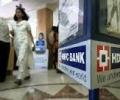
HDFC Bank's shares fell by 3.46 per cent to close the day at Rs 659 on the BSE. In intra-day session, the scrip lost 4 per cent to Rs 655.10.

This is a good opportunity for long-term investors to pick quality small and midcap stocks at reasonable valuations.

FDs are not advisable for long-term wealth creation as their post-inflation, post-tax returns are not very attractive.

Textile stocks have exhibited a mixed performance so far this calendar year (CY23), amidst higher domestic cotton prices and tepid global demand. Shares of Page Industries, Dollar Industries, Lux Industries, and VIP Clothing have declined up to 13 per cent so far in CY23, as against a 9 per cent jump in the S&P BSE Sensex. On the contrary, shares of Arvind, Welspun India, Raymond, and Gokaldas Exports have gained up to 51 per cent, during the same period.

'In phases when smaller stocks do well, an equal-weight index performs better than its market cap-weighted peer.'
The rupee plunged 58 paise to close at an all-time low of 81.67 (provisional) against the US dollar on Monday as the strengthening of the American currency overseas and risk-averse sentiment among investors weighed on the local unit. Moreover, escalation of geopolitical risks due to conflict in Ukraine, a negative trend in domestic equities and significant foreign fund outflows sapped investor appetite, forex traders said. At the interbank foreign exchange market, the local currency opened at 81.47, then fell further to close at an all-time low of 81.67 against the American currency, registering a decline of 58 paise over its previous close.

Lower crude oil prices and a rally in domestic equities restricted the losses to some extent, forex dealers said. At the interbank foreign exchange market, the domestic currency opened weak at 79.50 per dollar.

Benchmark stock indices Sensex and Nifty rallied more than 1.6 per cent to close at lifetime high levels on Thursday following buying in banking, oil and auto shares and a record dividend payout by the RBI to the government. Regaining the 75,000 level after its best single-day gain since January 29, the 30-share BSE Sensex closed at all-time peak of 75,418.04, up by 1,196.98 points or 1.61 per cent over the last close.

Stocks of defence-related companies have been firing on all cylinders on the bourses in calendar year 2023 (CY23). Shares of Hindustan Aeronautics (HAL), Bharat Electronics (BEL), Bharat Dynamics (BDL), Data Patterns, MTAR Tech, Cochin Shipyard and GRSE have rallied in the range of 21-96 per cent so far this year. By comparison, the BSE Sensex is up 8 per cent. The gains have been sustained on the back of robust export opportunities, a healthy project pipeline and the government's continued push for local manufacturing and indigenisation of defence equipment.

rediffGURU Ramalingam Kalirajan answers your personal finance queries.

The mutual fund (MF) industry has seen a fair number of new entrants in the last 10 years but none of them have proved to be much of a challenge for the larger players. The list of top 20 fund houses, which manage over 90 per cent of the industry's total assets, continues to be dominated by players who have been in the business for more than a decade. Bajaj Finserv MF may change that, say experts.

The rupee depreciated 11 paise to a record low of 78.96 against the US dollar in opening trade on Wednesday, weighed down by persistent foreign capital outflows. At the interbank foreign exchange, the rupee opened on a weak note at 78.86 against the American dollar, then lost ground to quote at 78.96 -- its all-time low level, registering a fall of 11 paise from the last close. On Tuesday, the rupee plunged by 48 paise to close at record low of 78.85 against the US dollar.

Wipro was the biggest loser among Sensex firms, sliding 2.32 per cent, followed by HDFC Bank, Power Grid, UltraTech Cement, ITC, ICICI Bank and Tata Motors. IndusInd Bank, Maruti, State Bank of India, Mahindra & Mahindra, Asian Paints and Bajaj Finserv were among the gainers.

The domestic stock market may face volatility amid the monthly derivatives expiry scheduled this week, while investors would mainly await the outcome of RBI's interest rate decision on Friday, said analysts. Global market movement would also continue to drive sentiment amid a bearish trend recently following rate hikes by the US Federal Reserve and other central banks. The Reserve Bank of India (RBI) may take cues from its global counterparts to raise interest rate for the fourth time in a row to control inflation.

However, in the last few sessions, the stock of Mukesh Ambani-controlled Reliance Industries Limited (RIL), hit its 52-week low level of Rs 2269.75, and has been one of the worst performers among the Sensex pack thus far in calendar year 2023 (CY23). Thus far in CY23, RIL has tanked nearly 11 per cent as compared to a fall of around 5 per cent in the S&P BSE Sensex. The fall in the stock, according to Gaurang Shah, senior vice-president at Geojit Financial Services is mostly due to the overall dip in the market sentiment, which in turn has impacted large-caps, including RIL.

The July-September quarter results of software companies in the engineering research and development (ER&D) segment were broadly in line with expectations, though there have been cuts in revenue growth guidance. While results were a mixed bag, and there are cautionary views on the near-term outlook, brokerages and global consulting firms highlight the strong growth trajectory for the sector. They expect this segment of the software sector to grow by 8-12 per cent going forward.

Younger people, who usually have a longer investment horizon which allows them to handle the interim volatility, may go for them.

The rupee plunged 20 paise to close at an all-time low of 78.13 against the US dollar on Monday, as a lacklustre trend in domestic equities and stronger greenback overseas weighed on investor sentiments. Forex traders said weak Asian currencies and persistent foreign capital outflows were the other major factors that dragged the local unit down. At the interbank foreign exchange market, the local currency opened at 78.20 and witnessed an intra-day high of 78.02 and a low of 78.29 against the US dollar.
rediffGURU Vivek Lala answers your income tax and personal finance queries.

Shares of most of the Adani group firms ended lower on Monday, with the group companies' combined mcap witnessing a sharp fall of Rs 9.5 lakh crore after US-based short-seller Hindenburg Research's adverse report.
